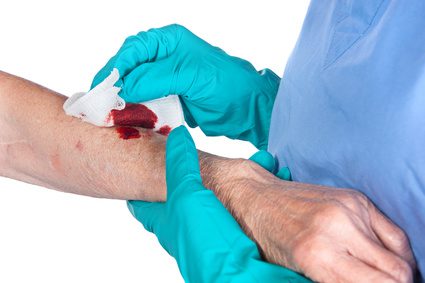
Last Updated 26th November 2025. Laceration injuries can result in serious blood loss, infection, and scarring. On top of that physical pain, lacerations can have lasting emotional and financial consequences for those affected. You should never have to suffer such an injury due to another party’s negligent actions, but you may be able to begin the laceration and scarring claims process to pursue compensation for your pain, suffering, and financial loss.
You are welcome to contact our advisory team at your earliest convenience to find out more. They will explain whether you can start a personal injury claim with one of our knowledgeable solicitors. However, enquiries are handled without any pressure to proceed, and our advisors are ready to answer any questions you may have.
Typical Questions On Laceration Claims
What is a laceration injury? This is when the skin and/or the underlying tissue are torn.
How are lacerations treated? Sutures/clips, steristrips, and tissue glue may be administered to treat lacerations.
How can accidents cause laceration injuries? Road traffic collisions, faulty or poorly maintained work equipment, and slips on unmarked wet floors in public places are common causes.
What is an example of a valid laceration compensation claim? You could claim for hand lacerations suffered while handling broken glass at work due to your employer not giving you protective gloves.
Can I claim for long-term scarring? Yes, and laceration compensation can account for the cosmetic and functional effects of your injury.
Reach out today for more straightforward answers and advice.
4.8 (466 reviews)
We're No Win No Fee Solicitors Trusted by thousands to win compensation.
Before discussing how much compensation per stitch in the UK amounts, let us understand what scars and lacerations are.
A laceration is a tear or a type of wound where the top layer of the skin (epidermis) gets separated from the deeper layers (dermis). It can occur due to an incision by a sharp object or an impact from a blunt object. If the skin laceration is minor, the wound won’t take much time to heal. However, deeper lacerations can cause scarring and may require extensive treatment.
On the other hand, a scar is a mark which remains on your skin after your injury has healed. This often occurs due to deep or penetrative wounds. There are five main categories of scars:
Fine-line Scar: It could be elevated in the beginning but usually flattens and fades away gradually, even without treatment.
Atrophic Scar: This usually occurs due to chicken pox or acne and could be a small, porous hole in the skin or a bigger, slightly sunken mark.
Keloid Scar: This is an elevated scar which often grows to be bigger than the actual wound. It usually doesn’t flatten or fade, and treatment can only help reduce itchiness or irritation.
Hypertrophic Scar: While this is usually elevated, it doesn’t grow bigger than the wound and flattens over time.
Contracture Scar: The skin around such a scar feels painful and tight. Such a scar usually occurs after a burn.
Unsure of whether your injury could form a basis for laceration and scarring claims? Contact our advisors now for a free consultation.
Compensation For Laceration And Scarring Claims
You may be wondering, “How much compensation per stitch in the UK can be awarded for laceration and scarring claims?”. While there is no set figure for this, we can tell you how successful claims are calculated.
There are two heads of loss that can potentially make up laceration compensation. These are called general and special damages.
General damages are awarded in all successful cases and compensates you for the way you have been physically and psychologically affected by negligence. Such factors will need to be considered when general damages are being valued:
Loss of amenity.
Pain severity.
How long the expected recovery period is.
During the claims process, you could be asked to have an independent medical assessment. The reports from this assessment can be used with the Judicial College Guidelines (JCG) by legal professionals to help them value your general damages
The JCG is a document that contains guideline compensation brackets for all sorts of injuries and illnesses.
Guideline Compensation Table
We have taken some injuries relating to lacerations and scarring from the JCG and have included them in the table below. The guideline compensation brackets, except for the first row, are also from the JCG.
However, none of these entries can be guaranteed since all laceration and scarring claims are unique.
Type of injury
Injury severity
Compensation bracket
Multiple serious injuries plus special damages
Serious
Up to £250,000+
Scarring to Other Parts of the Body
This bracket applies to scars caused by significant burns that cover more than 40% of the body
Likely to exceed £127,930
A singular disfiguring scar or multiple noticeable laceration scars
£9,560 to £27,740
Scarring With No Severe Internal Injuries
In the region of £10,550
A single noticeable scar, or several superficial scars
£2,890 to £9,560
Facial Disfigurement
Very severe scarring (a)
£36,340 to £118,790
Less severe scarring (b)
£21,920 to £59,090
Significant scarring (c)
£11,120 to £36,720
Less significant scarring (d)
£4,820 to £16,770
[link_btns_2]
Special Damages
Special damages are awarded in some successful claims and compensates you for the way you have been financially affected by negligence, such as:
Loss of earnings for needing time off work to recover from your injuries.
Medication costs, such as prescriptions.
Travel expenses for attending medical appointments.
Since special damages are not always awarded, evidence is crucial. Some types of evidence you should keep to prove your financial losses include payslips, bank statements, invoices, and receipts.
Please contact us and discuss your circumstances with our team to find out whether you’re entitled to laceration compensation.
Laceration and Scar Compensation Claiming Criteria
When seeking laceration or scar compensation, you’ll need to determine if you meet the eligibility requirements. As with any type of valid personal injury claim, your injuries must have been caused by a relevant third party breaching their duty of care.
There are various situations where you are owed a duty of care, such as:
In the workplace: Per the Health and Safety at Work etc. Act 1974, your employer must do what is reasonably practicable to ensure your safety and well-being while in the workplace and working. This is the duty of care they owe you.
In a public place: Those in control of public spaces have a duty of care to ensure visitors are reasonably safe whilst using their premises for its intended purposes under the Occupiers’ Liability Act 1957.
On the road: Road users are expected to abide by the rules and regulations set out in the Road Traffic Act 1988 and the Highway Code. Per their duty of care, they must also navigate the roads in a way that prevents injury to themselves and others.
If any of these parties breach their duty of care and this causes you to suffer a laceration or permanent scar, a compensation claim could arise.
As such, here is the personal injury claims eligibility criteria:
An employer, occupier, or road user owed you a duty of care.
They breached their duty of care.
You were injured as a result of this breach.
The above criteria forms the basis of negligence.
Continue reading to find out the time limit for starting a personal injury claim and gathering supporting evidence for your case. Alternatively, if you want to know how much compensation per stitch is in the UK, you can contact our advisory team.
Time Limit For Scarring And Laceration Injury Claims
If you are eligible to make a personal injury claim for a scarring or laceration injury, you should be aware of the relevant time limit to start proceedings. The Limitation Act 1980 establishes that there is generally a three-year time limit for starting a personal injury claim. This time limit applies from the date your injuries occurred.
This time limit has certain exceptions in place. For example, if a child has suffered a laceration or scarring injury, then the time limit is paused until the day of their 18th birthday. A claim could be made on the child’s behalf by a court-appointed litigation friend before this day comes. If this does not happen, the injured party will have three years to start their own claim once they turn 18.
If someone lacks the required mental capacity to make their own claim, the time limit will be suspended permanently. A claim could be made for them via a litigation friend. However, if they later regain the required mental capacity and a litigation friend hasn’t made a claim on their behalf, then the time limit will apply from the date of recovery.
To learn more about the time limits or other aspects of laceration and scarring claims, contact our advisors today.
How To Prove A Laceration Injury Claim
Following a laceration injury caused by the negligence of someone else, if you seek to make a claim, it’s important to gather supporting evidence. If you cannot provide evidence that negligence occurred and you subsequently suffered harm, you will likely struggle to claim personal injury compensation.
To give you an idea of what evidence to gather, we’ve included some examples below:
Your medical records can prove that you have suffered injuries such as an arm laceration.
An independent medical expert can offer insight into the extent of the harm you have suffered through a medical assessment.
Take photographs of your injuries. A photograph can show how severe an injury such as a foot laceration is.
Request the contact details of any witnesses to your accident. They can offer a statement later on in the personal injury claims process.
Proof of financial losses. For example, you could use a wage slip to show any loss of earnings you might have suffered.
There may be other forms of evidence you could collect. However, you can speak to our advisors at any time to discuss other examples of evidence. Furthermore, they could connect you with one of our experienced personal injury solicitors who can help you obtain supporting evidence.
4.8 (466 reviews)
We're No Win No Fee Solicitors Trusted by thousands to win compensation.
If you are starting a personal injury claim for laceration compensation, you should seek the support of our excellent solicitors. This is because they are specialists in such claims, having undergone extensive training. As such, they have helped our clients gain over £80 million in compensation for their injuries and losses.
Our solicitors may also support you by:
Walking you through the laceration and scarring claims process
Explaining any legal terminology associated with your claim
Helping you collect evidence to support your claim
Offering their services on a No Win No Fee basis
Explaining how personal injury compensation is calculated
Setting you up with appointments, such as independent medical assessments
Negotiating compensation settlements with third parties on your behalf
At Legal Expert, we understand the impact that scars and lacerations may have on your health and day-to-day life. Therefore, our solicitors and advisors will provide excellent customer service to guide you throughout the entire claims process, supporting you at every step.
Further, our solicitors will utilise their legal skills, knowledge and experience to help you claim the compensation you deserve for your suffering.
If you would like to know more benefits of claiming with our solicitors, please contact our friendly advisors.
No Win No Fee Laceration And Scarring Claims
Now that you know more about laceration and scarring claims, you may be interested in finding a solicitor to help you with your specific case. Our solicitors are experts in personal injury law and may be able to help you under a Conditional Fee Agreement (CFA).
A CFA is a kind of No Win No Fee agreement. Under this type of arrangement, you don’t have to pay any upfront fees in order for your solicitor to start working on your claim, nor do you pay any ongoing fees for their continued services. Similarly, if your claim doesn’t succeed, you won’t pay any fees for your solicitor’s work on your case.
However, if your laceration injury compensation claim does succeed, then your solicitor will take a success fee. This fee is taken directly from your compensation as a small percentage, though this amount is limited by a legal cap. This helps to make sure that the larger share of what you receive stays with you.
To find out if one of our expert solicitors could help you claim personal injury compensation, contact our team of advisors today. They can evaluate your claim for free and answer any questions you might have about the personal injury claims process. To get started:
 Skip to content